Sunday, 10 June 2007

Costly Engineering Mistakes - The Airbus A380


A blogger's perspective, not necessarily the most factual one, on the causes of delivery delays of the Airbus A30 and the costs of these mistakes.

The Airbus A380 is the world's largest commercial aircraft to be ever built. It could accommodate a total of 853 passengers in the full economy seat configuration and has a 15200km flight range. To build an aircraft this size, technical and technology boundaries were undoubtedly redefined. The aircraft mammoth wings, a case in point, is the first to be built with a wing cross-section that is smoothly contoured, instead of wings that are partitioned in sections. This design feature increases aerodynamic flow and reduces drag, thereby boosting fuel efficiency.


The airbus A380 will also be remembered for its delivery delays amounting to no less than two years. Airbus attributed the delays to the 530km of wiring in each aircraft as the primary reason. Initial analysis by airbus engineers and independent consultants reported that the wiring problems can be resolved by having more resources on the deck and can be rectified in six months. However, a second more in-depth analysis conducted after the first six months of delay reveals a different picture - the use of different incompatible versions of computer 3D software and poorly managed change control and change management procedures were the actual causes . There were also other engineering defects unveiled during the battery of tests conducted, such as landing gear problems and weight issues which lead to another delay.


In total, the airbus A380 project saw a change of 3 Aribus CEOs, an EADS (parent company of Aribus) CEO, a A380 progam manager and spiraling costs which is now estimated at a cost of 12 bn euros, a cost overrun of 1.5 bn euros. Not to mention the loss of goodwill amongst clients due to the long delays.
The airbus A380 is due to deliver the first plane to Singapore airlines in Oct 2007.

Wednesday, 6 June 2007

Costly Engineering Mistakes

Was just reading about some of the world's great engineering feats and some of the mistakes made. Have decided to dedicate a section of the blog to some of these mistakes and the mammoth costs incurred as a result. Shall start off with the Airbus A380, since it will be beginning commercial flights soon, in Oct 2007.

Wednesday, 30 May 2007

Cooling the London Underground


Plans to install giant chillers in London Tube stations Oxford Circus, Waterloo and Euston in order to save commuters from the merciless heat in summer were unveiled yesterday by the London Transport Authority. Other measures include pumping air, cooled by the water in River Thames, into the Victoria Station, and installing fans across 50 other stations. This measures are part of a £150 million scheme to cool the century old London underground.

Last summer, temperatures reached as high as 47 degrees Celsius and the mercury is expected to set new highs, judging by the mild winter this year.

I have came up with a couple of ideas to see me through summer as I commute in the London underground:

* Use the DLR whenever possible - it is more spacious and there are windows in the cabins which can be opened
* Travel earlier so as to allow the morning rush hour. Evenings should be fine when the temperature drops
* Carry a bottle of water with me
* Sit near the ventilation vents (usually the middle seats on the Northern Line)
* Stand near the end/start of each cabins - there are windows there pray hard that they can be opened

Am taking 2 weeks off in Singapore during August, so I should at least be able to escape 2 weeks of sticky London commute and enjoy the air-conditioning in the SMRT trains. Phew!

Tuesday, 29 May 2007

Maglev train gets shelved in China


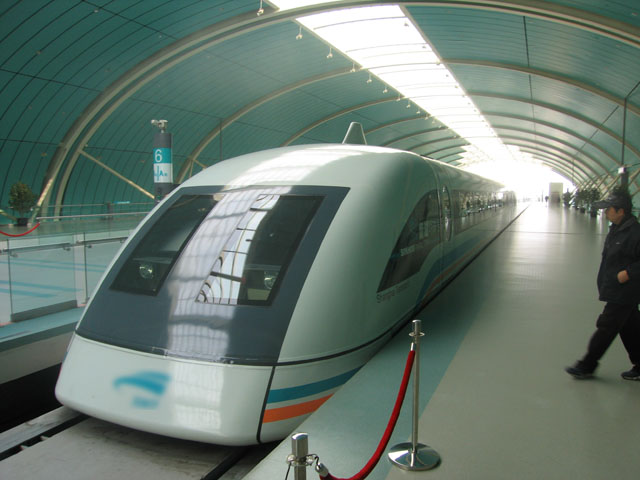
I could still remember the time I took the Maglev train in Shanghai. The trip lasted less than 8 minutes from start to finish and all throughout the ride, I was fixated with the digital speedometer displayed at the front of the cabin. The train reached a maximum speed of about 380km/h for less than 30 seconds before decelerating gracefully into its destination. The joyride was over before I even had the chance to kick off my shoes.

A couple of days ago, it was announced that the plan to extend the current maglev line to Hangzhou was put on hold, partly due to concerns regarding 'health' reasons - radiation. Residents living along the proposed route had been petitioning against the plan and seems that their opposition has borne fruit. I can't help but draw parallels about the residents' concern with magnetic mattresses which were once a rage. Imagine the maglev as a huge magnetic mattress, hey you reap all the benefits simply by living near the maglev line, without having to spend a single cent.

Monday, 28 May 2007

Clash of railway civilisations

Finally,the high-speed rail linking France and Germany will soon be a reality. This project had spent almost 10 years in the sidings because of Franco-German quarrels about coffee cups, braking systems, on-board handcuffs and little red flags.

So exactly what was their disagreement about?


High Speed Trains - German Left, French Right

The French had to meet German standards: stronger brakes because Germany insists on shorter braking times, drinkable water in the lavatories and real porcelain rather than plastic crockery in the dining car. This was almost akin to telling the French how they should eat and the French countered with their own standards:

French trains have a special seat with metal rings to hold any criminal detained on board; the German trains did not. Each French train has, under rules drawn up in the steam age, an emergency kit that includes red flags and flares – pointless, say the Germans, when travelling at these kinds of speeds. The new German trains, in order to meet French specifications, now have three wiring systems and five different fuses.

But before the French were wholly satisfied, the Germany trains had to complete 120,000km of tests and more than 30 drivers had to pass an exam in the French language. But the biggest non-technical sticking point was the refusal of French ticket inspectors to serve coffee and meals to first-class customers. This is a normal part of the service for German ICE trains but was a step too far for the proud controlleurs. German inspectors will now double as waiters for the whole journey to Paris.

Now, for as for the planned railway link between Singapore and Malaysia, I wonder what would be their sticking points?